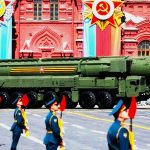
Ukraine’s Air Force Reports Russia Launched Intercontinental Ballistic Missile in Thursday Morning Attack
Ukraine’s air force has announced that Russia fired an intercontinental ballistic missile (ICBM) from its territory during an attack on Thursday morning. This marks the first time Moscow has employed such a weapon in the ongoing conflict.
While the Ukrainian statement did not specify the missile’s target or whether it caused significant damage, the development comes after Ukraine recently used UK-supplied Storm Shadow missiles to strike targets within Russia for the first time.
The UK government has not officially commented on the reports, though Defence Secretary Ben Wallace remarked that “Ukraine’s action on the battlefield speaks for itself.”
An intercontinental ballistic missile (ICBM) is a type of long-range missile designed to travel from one continent to another. These missiles are capable of carrying conventional or nuclear warheads and are specifically built for delivering powerful payloads over extremely long distances — typically 5,500 kilometers (about 3,400 miles) or more.
Key Features of an ICBM:
- Long Range: ICBMs are capable of traveling across vast distances, often between continents. For example, a missile launched from Russia could reach targets in the United States, or vice versa.
- Ballistic Trajectory: After launch, an ICBM follows a ballistic trajectory, meaning it is powered by its engines only for the initial phase of flight. Once the missile reaches the edge of space, it then follows a downward, arcing path back to Earth, re-entering the atmosphere before hitting its target.
- Nuclear Capabilities: ICBMs are most famously associated with nuclear weapons. They are a key component of many countries’ nuclear deterrence strategies, as their long range and payload capacity make them capable of delivering a devastating nuclear strike far from their launch sites.
- Speed and Precision: ICBMs travel at extremely high speeds, often faster than the speed of sound (Mach 5 or higher), and can be equipped with multiple independently targetable reentry vehicles (MIRVs), which allow a single missile to carry multiple warheads to different targets.
- Launch Platforms: ICBMs can be launched from various platforms, including land-based silos, submarine-launched platforms, or mobile ground-based systems.
Phases of an ICBM Flight:
- Boost Phase: The missile is launched with the help of powerful rockets. This is the phase where the missile accelerates into the upper atmosphere.
- Midcourse Phase: The missile enters space and travels along a predictable trajectory. This phase takes the longest time and is the phase where interception is most difficult due to the missile’s high speed and altitude.
- Reentry Phase: The warhead(s) re-enter Earth’s atmosphere and accelerate toward the target, where they can hit the target with high precision.
- Impact Phase: The missile reaches its destination, and the warhead(s) detonate, causing massive destruction.
Strategic Importance:
ICBMs are considered a cornerstone of nuclear deterrence. Their long range, rapid delivery, and ability to carry nuclear warheads make them a powerful tool in a country’s strategic defense posture. The fear of a retaliatory nuclear strike from an adversary holding ICBMs is a key part of the doctrine of Mutually Assured Destruction (MAD), which aims to prevent direct conflict between nuclear-armed states.
Current Usage:
- While initially developed during the Cold War, ICBMs remain part of the arsenals of nuclear powers such as the United States, Russia, China, and others.
- The launch of an ICBM is often seen as a dramatic escalation in any conflict, as it implies the use of weapons of mass destruction, particularly nuclear warheads.
In summary, an ICBM is a highly sophisticated and destructive weapon designed for long-range attacks, often with nuclear payloads, and its use in a conflict represents a severe escalation with global ramifications.